From academic research to the industrial circular economy: the partnership between Grassano SpA and the Polytechnic University of Milan at Ecomondo 2026
An excellent synergy between the academic world and industrial leadership in hazardous waste treatment: the new strategy for oily sludge recovery at the heart of Ecomondo 2026.
Summary
- Partnership: Grassano SpA (Riccoboni Group) and the Radiochemistry and Radiation Chemistry Laboratory at the Polytechnic University of Milan (POLIMI)
- Project Team: Tommaso Marcuzzo and Francesco Galluccio (POLIMI), working closely with Michele Bellandi, Umberto Quaglieri and Elisa Vittoria Ghiggini (Grassano SpA)
- Project Team: Tommaso Marcuzzo, Dr Francesco Galluccio, Dr Eros Mossini and Prof. Mario Mariani (POLIMI), working closely with Michele Bellandi, Umberto Quaglieri and Elisa Vittoria Ghiggini (Grassano SpA)
- Research Subject: Treatment and recovery of industrial oily sludge
- Development Level: TRL 4 (Laboratory validation on real samples)
- Context: Officially presented at Ecomondo – The Green Technology Expo 2026 (Rimini), at the Riccoboni Group’s pavilion.
Innovation at Ecomondo 2026
As part of the ecological transition and technological innovation for the circular economy, the scientific partnership between Grassano SpA and the Polytechnic University of Milan was consolidated at Ecomondo 2026.
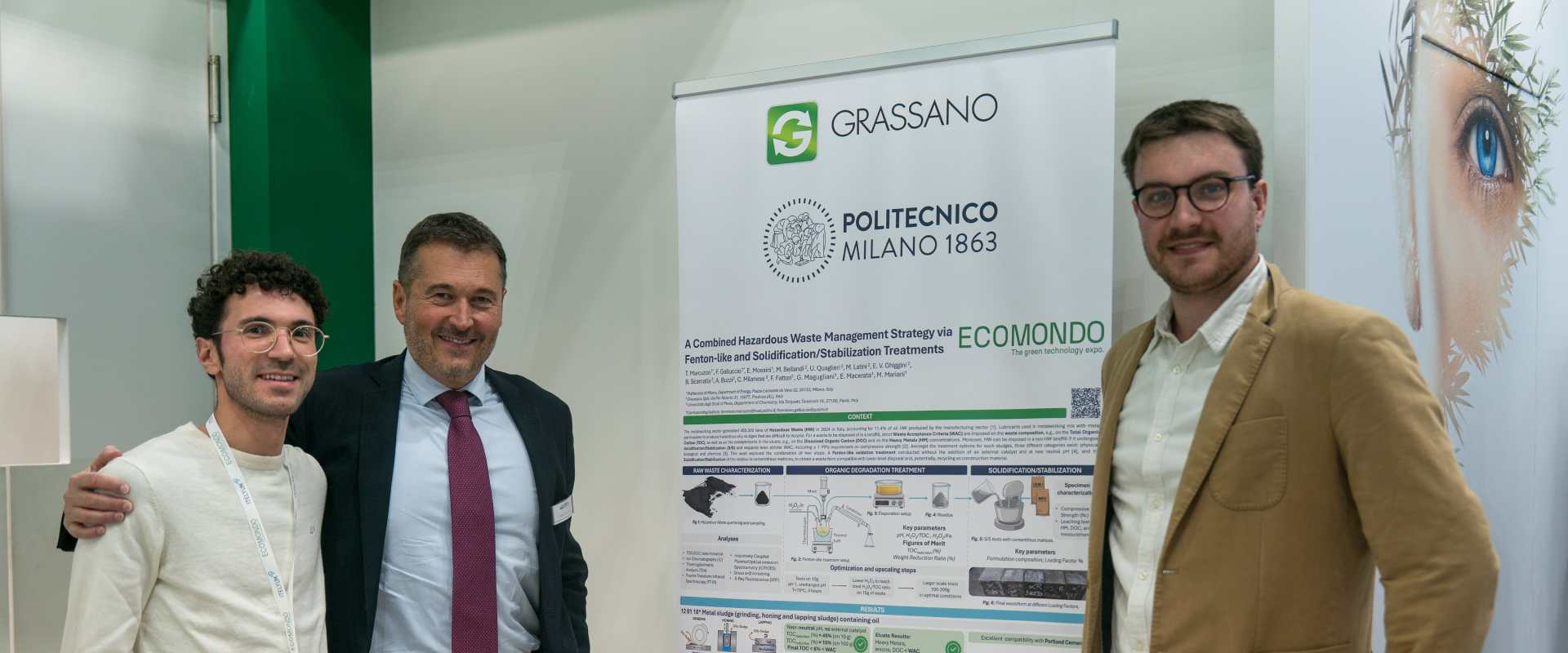
At the Riccoboni Group’s pavilion, the researchers Tommaso Marcuzzo and Francesco Galluccio from the POLIMI Radiochemistry and Radiation Chemistry Laboratory presented the scientific poster entitled:
“A Combined Hazardous Waste Management Strategy via Fenton-like and Solidification/Stabilization Treatments”.
This milestone represents the brilliant outcome of a collaboration launched in late 2025, which also led to Tommaso’s Master’s thesis in Industrial Engineering, and shows how structured cooperation between universities and business can produce real solutions for the most complex environmental challenges.
The challenge: how to manage certain hazardous waste
The Italian metalwork sector generates about 455,000 tonnes of hazardous waste every year (accounting for 11.4% of the total hazardous waste produced by the manufacturing industry). In particular, metal forming and machining processes produce oily sludge that is extremely complex to treat and recycle: featuring high concentrations of organic contaminants and heavy metals, this waste requires advanced, rigorous treatment before it can be sent for final disposal.
The combined strategy (TRL 4)
The heart of the project lies in a combined treatment process, developed on a laboratory scale using real industrial waste samples provided by Grassano SpA and validated through analysis conducted at the POLIMI and Tecnoambiente S.r.l. laboratories.
This method uses the industrial know-how and recent patent of the Polytechnic’s research group (an integrated technology developed for the treatment and conditioning of spent ion-exchange resins, available here), organising it into two key phases:
1. Fenton-like wet oxidation process: Innovative waste oxidation carried out at a neutral pH level and without any external catalysts added. This helps reduce the organic fraction well below the regulatory threshold of 6 wt.%, a fundamental requirement for acceptance to hazardous waste landfills.
2. Solidification/Stabilisation: The safe confinement of the residue obtained in specially designed cement matrices. This phase stably immobilises heavy metals and residual organic contaminants, ensuring full compliance with strict landfill acceptance criteria.
Results, Publications and Future Prospects: Towards Scale-Up
The treatment developed helps transform hazardous oily sludge into stable, non-reactive matrices, ready for disposal in non-hazardous waste landfills and, looking ahead, paving the way for recovery processes of the post-treatment residue as construction or industrial aggregate.
Alongside presenting the poster at Ecomondo 2026, the research team is finalising a scientific article that will shortly be published in an international journal, further consolidating the academic and industrial relevance of the technology.
Looking ahead, the collaboration between Grassano SpA and the Polytechnic University of Milan will continue with a clear, shared goal: to proceed with scaling up the process. The next step will involve implementing the technology on a larger scale, ultimately aiming to develop an operational industrial prototype, ready to be integrated directly into treatment plants to maximise the efficiency and sustainability of the production cycle.
The added value of working together
What makes this project a successful model is the close synergy between the teams involved:
- Grassano SpA (Riccoboni Holding Group), thanks to the constant support and valuable contribution of Michele Bellandi, Umberto Quaglieri and Elisa Vittoria Ghiggini, brought its experience to the table. Their support was vital not just in providing real samples and a vision focused on industrial plant feasibility, but also in helping the research team navigate the complex regulatory framework governing hazardous waste management in Italy, aligning the research right from the outset with strict legislative requirements.
- The Polytechnic University of Milan, thanks to its wealth of prior knowledge and experience in the field of radioactive and non-radioactive waste management, and thanks to the facilities, infrastructure and equipment at the Radiochemistry and Radiation Chemistry Laboratory of the Nuclear Section of the Department of Energy, brought a rigorous methodological approach, frontier research and the ability to innovate starting from recent academic patents.
This synergy between theory, legislation and operational practice will help shorten technology transfer timelines, transforming an environmental issue into an opportunity for sustainable growth.